
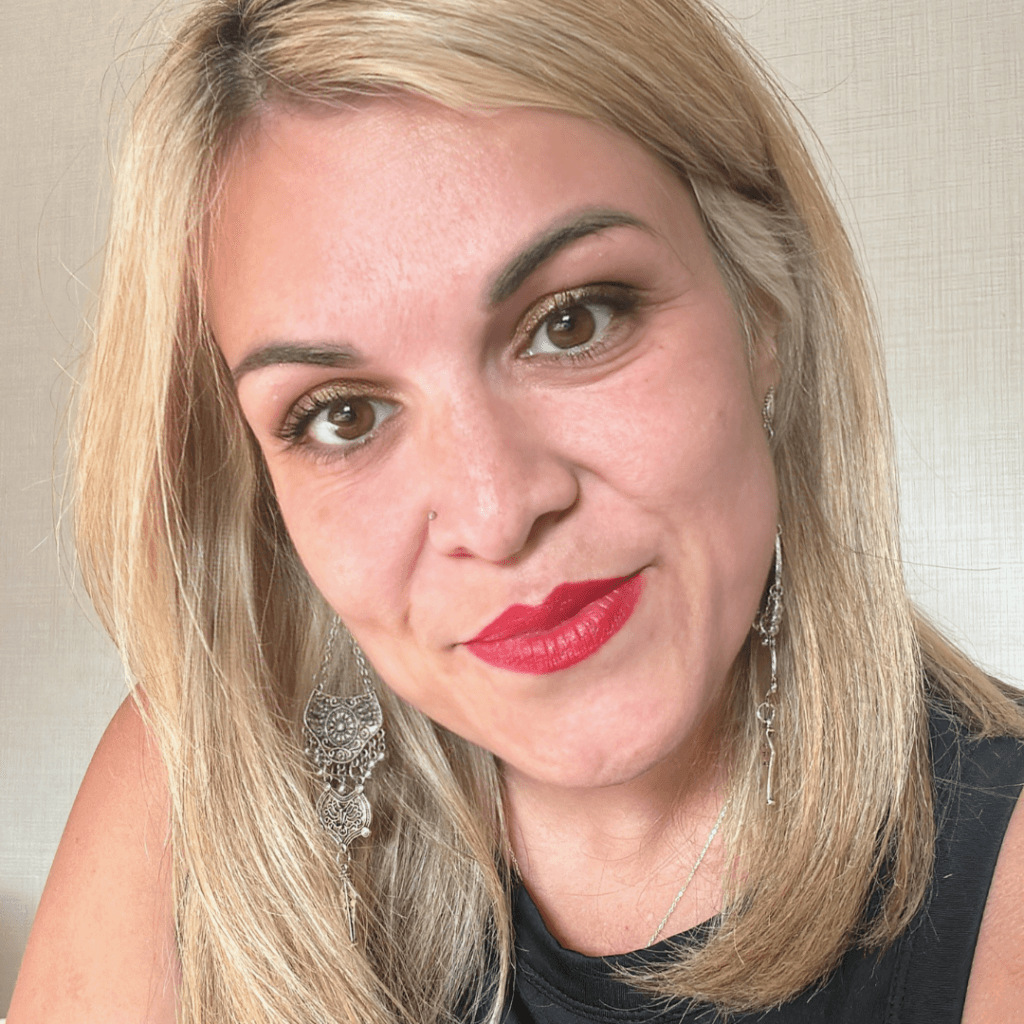
My name is Veronica, and I was a working mom to a 5-year-old little guy on the autism spectrum. My days were busy… 6am wake-ups to get lunches made and clothes ready. Drop-offs at school, driving to work, working all day, picking up my son, heading to therapies, then finally home by 7pm. And all of this seemed reasonable. That was my life. I was burning the candle at both ends and didn’t even think it was abnormal. That was until we were all forced to stop and sit still during the pandemic.
Dylan had just started junior kindergarten in September. He was hyperactive and out of his normal routine — and working a full-time virtual job with a neurodivergent 5-year-old who refused to sit in front of an iPad for virtual school? Nearly impossible.
When I was home with him, I would set up my laptop on the kitchen table next to his iPad and say “Let’s do some work!” to try to get him to sit for even a few minutes to participate in the daily lessons. But nothing held his attention. So, I would leave the iPad on so that he could still hear the teacher and kids, as he played in the living room, lining up his toys or colouring.
Part of my job was to host virtual orientations for new employees on Mondays. This became the most challenging day to deal with Dylan. I would try to set him up in his room with the TV on, playing a movie he liked, his iPad charged and loaded with games, books, blocks and toys he loved, and try to convince him to ‘play’ for the 2.5 hours I needed to present. You can imagine, this didn’t work out as planned.
One time, he stripped down to nothing and walked into the background of my virtual orientation. I quickly saw his little butt reflected in my screen and turned off my camera… but forgot to mute myself. Thankfully, these orientations are a two-person team and my coworker quickly jumped on and covered the orientation while I tried to get Dylan out of the room, but because I forgot to mute myself, they could hear me yelling at him to go put on some clothes and go back to his room. Not my best moment. And this is where I think it all started to crack for me.
As the days went on, I became anxious and heightened. I would snap at anything, and I would get upset easily. I started avoiding doing household tasks because it all seemed like too much. I didn’t know how to sit still for too long. I often went on hour-long drives with Dylan, just to get us out of the house.
And during this time, I developed a BFRB (body-focused repetitive behaviour) where I picked at my face, legs, and bit my cuticles raw. I spoke to my doctor and she prescribed an antidepressant. But the skin-picking was truly bad, and I decided to start a 6-week therapy group for BFRBs.
One of the causes, the psychotherapist mentioned while explaining what might cause someone to skin-pick was, ADHD as a potential cause. She said that there was high comorbidity between the two, explained by the need for stimulation, poor impulse control, and that it could be driven by dopamine deficiency.
This piqued my curiosity.
When my son was diagnosed at 3.5 years old, I started doing a lot of research into autism and its causes. Genetics was one of the main drivers, and this made sense to me. My brother was diagnosed with ADD when he was just 5 years old and started medication, as he was a super hyperactive child. But I was not like that. I wasn’t hyperactive. I did, however, always talk too much in class and get in trouble for it. I would not sit still (always shaking my leg) and usually needed something to fidget with during lessons. I was forgetful and disorganised. And I was always “too sensitive” according to everyone around. I started projects and never finished them. But I could get hyper-fixated on a topic and learn everything about it. I hated being called on to read out loud or answer a question in class. All things I now know are ADHD traits in girls.
I asked my psychotherapist if I could book a separate appointment to discuss this with her.
At that appointment, we chatted about my past experiences, and she completed the DSM-5 questionnaire for ADHD, and guess what? She concluded that I did, in fact, qualify for a diagnosis of ADHD.
It did take a long time to get an official diagnosis. But eventually, I was weaned off the antidepressant and started taking Vyvanse. And this medication changed everything for me.
For the first time in my whole life, my mind was quiet. I cried the first time I took it.
For so many years, I would describe to people that my brain was like a computer with multiple tabs open, all running at the same time. And now, I would take my medication and I would be able to focus on just one task. And complete it. And had the motivation to do it.
It was insane to me how much of my life I realised I was struggling. Masking. Just getting by because I had to.
Getting diagnosed as an adult is something that seems to be happening to a lot of people recently, from what I can read and see on social media. People telling stories of years of struggles and the relief they felt once they knew exactly why they were the way they were.
It may have taken the craziness of the pandemic to throw me into a spiral to finally get this figured out, but my goodness, am I happy it did.

When I was growing up, many people thought I was a... Read More

If you have ADHD, being able to juggle multiple wo... Read More

For most of my life, I thought I was just a train... Read More

After-school meltdowns, anger or tears that seem t... Read More

When I was diagnosed with ADHD at 48, it didn’t fe... Read More
