

Shaming has been the name of the game for kids with ADHD for a long time. I expect it became a problem at about the time mankind stopped living in the world and started trying to control it instead.
There was no need for children to behave like little adults until we started making them sit still for long periods of time at dining room tables, in church pews and in classrooms. At that point, the shaming of the neurodivergent began in earnest. This cartoon from the 1800’s typifies the treatment that ADHDers have been subjected to over the past few centuries.
Fidgety Phil
“Let me see if Phillip can Be a little gentleman; Let me see if he is able
To sit still for once at the table.” Thus, Papa bade Phil behave; And Mama looked very grave. But Fidgety Phil,
He won’t sit still; He wriggles, And giggles,
And then, I declare,
Swings backwards and forwards, And tilts up his chair,
Just like any rocking horse—“Philip! I am getting cross!” See the naughty, restless child
Growing still more rude and wild, Till his chair falls over quite.
~ by Heinrich Hoffman, 1809–1894

“Fidgety Phil” is thus labelled naughty, rude and wild. His behaviours, caused by the neurodivergence of which Phil has neither control nor understanding, become his personal flaws and deficiencies. The adults Phil interacts with continually remind, ridicule and punish him for his (perceived to be intentional) shortcomings and, before long, Phil will internalize these characteristics, believing himself to be all of the reprehensible things these responsible adults have told him he is. His guilt, shame and self-limiting beliefs will follow him throughout his life, becoming self-fulfilling prophecies. How much better are we doing now?
Following are comments found on a typical report card received by an extremely bright six-year-old boy with undiagnosed ADHD, either mixed or hyperactive type. Let’s call this little guy Phil!
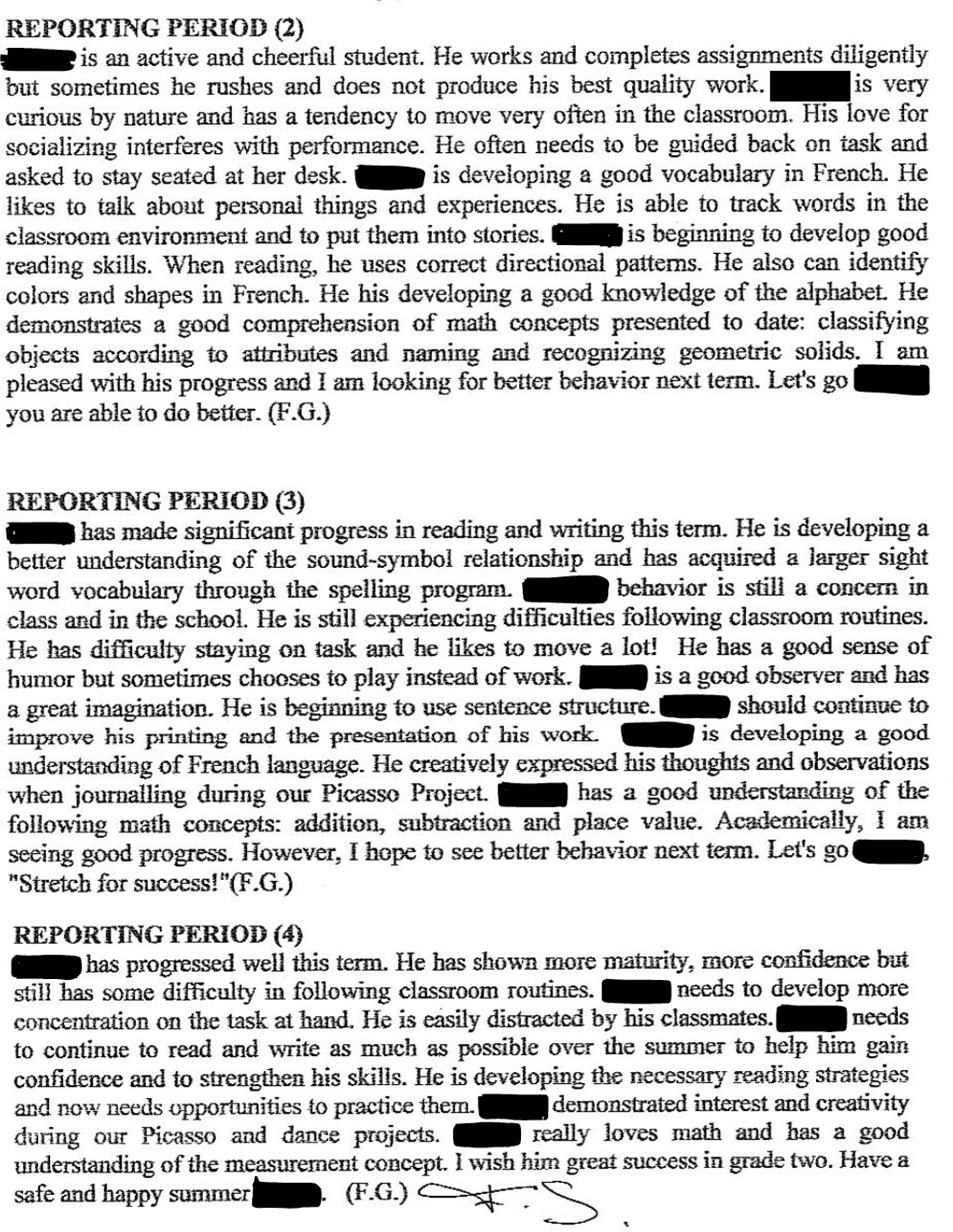
The comments related to Phil’s abilities in reading, writing and arithmetic make him sound like the kind of kid who’ll be his high school valedictorian one day. In fact, Phil’s IQ is in the 150-160 range.
Unfortunately, all of the comments directed towards Phil’s behaviour foretell of a child whose academic accomplishments are likely to erode year after year to the point where graduating from high school at all will be a challenge. That is, in fact, Phil’s story.
Phil and children like him are chastised, report card after report card, year after year, for actions and behaviours over which they have no control. Over and over again they are told that they are not enough, that they:
Their teachers believe these things to be true. They also apparently believe that repeatedly telling kids like Phil that they:
Phil and others like him, both boys and girls, are punished further when they fail to correct their “bad behaviour” despite all of the painful judgements being directed at them about their character faults. This can take the form of detentions, extra homework, missing out on field trips, being kept inside during recess, having to clean the blackboards, having to sit at the front of the class or in a corner by themselves, all the way up to expulsion, which only adds to the trauma to which these kids are already being subjected. Not to mention the punishments,which may include physical punishments, they receive at home for all of their perceived failures at both home and school.
Take another look at Phil’s report card. His behavioural “problems” (Phil clearly exhibits some of the most common symptoms of ADHD) were mentioned some 20 times over the three paragraphs, appearing in two out of three lines on average.
Kids like Phil don’t just experience this level of trauma and public humiliation at report card time; they are subjected to it daily. They are told that they are “less than” multiple times most days over many, many years. Some experts estimate that, on average, by age 10, children with ADHD will have received a full 20,000 more negative messages about themselves than their neurotypical friends. The result is that many spend their lives believing themselves to be fundamentally and hopelessly flawed.
No amount of being belittled, chastised, singled out, punished, or even growing up, will transform a neurodivergent brain into a neurotypical one. Kids like Phil suffer ongoing trauma throughout their childhood when they should be being given the tools, therapies accommodations, and medications that would allow them to become the students everyone, including they themselves, want them to be.
Instead, unrelenting chastisement, ridicule and punishment means that many receive the gift of complex post-traumatic stress disorder (C-PTSD) to go along with their ADHD. And having internalized these negative beliefs about themselves and what they are and are not capable of, they put self-limiting restraints on who they might otherwise have become.
Although Phil and others like him are likely to achieve much less in their lives and will have a much harder time negotiating their lives than what might have otherwise been the case, the Phils of this world often make it through life more or less in one piece.
Those with lower IQs tend not to fare as well. Research shows that an extraordinarily high percentage of people with ADHD become high school drop outs and/or teenaged parents, regularly lose their jobs, are often under employed, become substance abusers, have difficulty with relationships and money, spend time in prison, and the list goes on and on. They live difficult lives which either end violently or by suicide at equally alarming rates.
Is it any wonder that the life expectancy of people with ADHD is between 6 and 10 years less than that of a neurotypical person? With their self-worth dying by the infliction of thousands and thousands of tiny cuts daily, beginning far too soon in their young lives, how could it be otherwise? Surely, we can do better.

Life inside an ADHD brain can be…unpleasant at tim... Read More

Growing up, my late father told me that I was “bor... Read More

Many of us ADHDers have heard about the analogy th... Read More

Many parents find themselves redefining what “home... Read More

This ADHD Awareness Month, CADDAC is highlighting... Read More
