
A recent study will be of interest to parents of children with ADHD who have a history of severe mental illness. The study looked at 141 children and young adults in Nova Scotia, taking stimulant medication, who have a parent with a history of serious mental illness such as a major depressive disorder, bipolar disorder, or schizophrenia. The study found that nearly two thirds of the study’s participants experienced a psychotic side effect such as hallucinations, delusions, hearing voices, and/or perceptual disturbances. Past research has shown that the same type of psychotic effects were found in one-quarter of children and young adults, with this family history, who had not taken these medications. While these side effects have been known for some time the quantity seen in this research was surprising.
Dr. Rudolf Uher at Dalhousie University in Halifax, the lead author of the study noted that this study by no means indicated that stimulant medication treatment, which can be very helpful for these children should be stopped, however it should alert physicians that they need to actively ask children and young adults about any unusual experiences. Dr. Uher noted that children rarely tell people about these experiences unless asked.
The study was not designed to prove cause and effect only that there was an association with taking these medications and psychotic effects.
Access additional information Here
Two large case-control studies from three Massachusetts health care systems has found no evidence that prenatal exposure to antidepressants increases the risk for autism or attention-deficit hyperactivity disorder (ADHD). Any increase of Autism or ADHD found in previous studies is thought to be due to the severity of the mother’s depression, which is a known risk factor, rather than the use of antidepressant medication.
These new finding should bring some reassurance to expectant mothers’ faced with a decision about taking antidepressant medication throughout their pregnancy.
The study looked at data form more than 1200 children with an autism related diagnosis and 1700 children with ADHD to control large groups of children with no neuropsychiatric diagnosis. The fact that both autism and ADHD incidence rates increased in children of women who were taking antidepressant medication or experiencing psychotherapy prior to becoming pregnant, indicates that the risk factor is actually the severity of the depression rather than use of antidepressants during pregnancy.
Dr. Perlis senior author of the report stated "While taking any medicine during pregnancy can be a difficult decision, we hope the results of our two papers - which now cover more than 2,500 children with autism and almost 4,000 with ADHD - will provide some reassurance to women concerned about getting treatment for depression or anxiety during pregnancy. While there are depression treatments that don't involve medication, for some patients they are not effective, available or preferred. We want women and the clinicians working with them to be as informed as possible when making this decision."
Access more information Here
Most parents are aware that their children with ADHD struggle with poor self-esteem and find it heartbreaking to hear their child voice negative comments about themselves like, “I’m stupid, I’m just so dumb I’ll never be able to do this”. Parents hate to see their kids discouraged, afraid to try difficult or new things and to hear their children lament that they feel misunderstood and that no one likes them. A child with ADHD will receive at least twice as many negative messages in a day than other children.
Sometimes as parents, educators, coaches and others who interact with these kids we are the ones who inadvertently or even intentionally relay these negative messages in the hope that it will alter the child’s behaviour. In fact, positive consequences in the form of verbal feedback, has been shown to be far superior in changing the behaviour of children with ADHD and I would suspect most children. Unfortunately as humans in the midst of busy lives we tend to pay attention to the things that annoy, interrupt or distress us and ignore our children and the things they are doing when they are behaving well or accomplishing what we have asked of them.
So parents will need to make a conscious effort and actively work on increasing their child’s view of themselves by balancing out all the negative messages their children are getting throughout the day with more positive feedback and experiences.
Here are several links to tips that you might find useful.
http://www.healthcentral.com/adhd/raising-child-with-adhd-192990-5_3.html
http://www.netdoctor.co.uk/conditions/adhd/a5237/self-esteem-and-adhd-child/
http://www.adhdtogether.com/sites/default/files/Ideas-help-build-self-esteem_COA.pdf
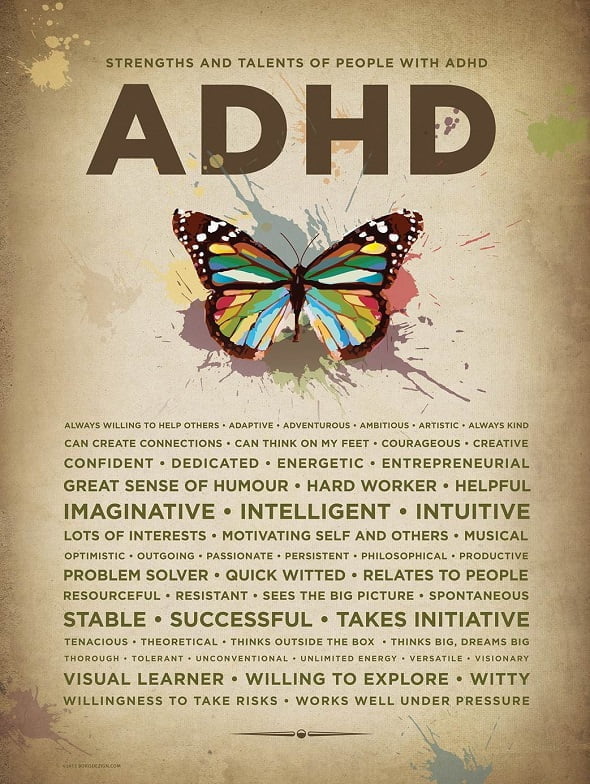
One mother Liz Wisnieski, a graphic designer who herself has ADHD, decided that her daughters Kathleen (11) and Sarah (8), needed an extra boost to their self-esteem. When her daughter Kathleen was upset about struggling at school and having to re-start medication, Liz printed out a list of famous inventors, musicians, artists, and athletes who were diagnosed with ADHD. She lit up.
Liz realized that her daughters along with most children were only hearing negative messages about ADHD and that’s when she decided that her daughter’s needed a more visual lasting message about the positives aspects of ADHD. She designed some posters to hang in her daughters’ bedrooms to remind them of all the positives of the condition. (See below) She hopes that these posters can help bring positive awareness of ADHD to as many people as possible.
You can purchase one of Liz’s posters at https://www.etsy.com/shop/ADHDPosters

Two ADHD media posts I viewed today demonstrate some examples of the right and the horribly wrong ways to deal with children with ADHD. A recent study out of the University of Buffalo shows that praise of the potential for rewards improves the performance of children with ADHD on certain cognitive tasks. Prior to this it was not known if increased motivation accounted for this improvement or if children with ADHD scored lower than other children on these tests so had more room for improvement. This study indicated that increased external motivation is a critical factor in improving the performance of children with ADHD. Positive reinforcement, rather than punishment is the corner stone of behaviour therapy for children with ADHD. The study looked at whether children with ADHD have an increased sensitivity to external motivation and found that this was indeed the case. This would make perfect sense when taking into consideration Russell Barkley’s information on Executive Functioning impairment and the role it plays in self-regulation and motivation.
On the other hand, it seems that many uninformed people still believe that negative consequences are the way to improve the behaviour of children with ADHD. In the news last night and in several posts today including the Huffington Post you can view a very disturbing video of a Sherriff’s deputy placing handcuffs on the biceps of an 8 year old as a consequence of misbehaving in class. Apparently this has happened before and a lawsuit has now been launched.
On Tuesday May 12, a CADDAC delegation had a great day at Queen’s Park. Building off the momentum of Mental Health Awareness Week (May 4-10), CADDAC Executive Director Heidi Bernhardt, Dr. John Tucker and Dr. Doron Almagor spoke with representatives from various ministries to raise awareness about ADHD and advocating for increased support and treatment options for those in impacted by this disorder.
In these discussions, CADDAC was able to advocate and raise awareness with numerous Ministry officials, including those from Health and Long-Term Care, Children and Youth Services, Education, Community and Social Services, and the Office of the Attorney-General.
As ADHD is one of those illness that continues to be lost in a haze of social stigmas and lack of understanding, these efforts are particularly important.
It is part of CADDAC’s mandate to take a leadership role in the advocacy of ADHD in all areas that affect people with ADHD, including education, health, support, employment, regulatory bodies and resources. These efforts were part of CADDAC’s efforts to fulfill this mandate, as we continue to strive to network with government, professional organizations, health care providers, educators and all other stakeholders to improve the lives of people with ADHD.
It’s time ADHD is seen for what it really is: a complex, multifaceted, often life-long mental health disorder that significantly impacts people’s lives, the lives of those closest to them, and society as a whole.
CADDAC is thankful to all the open dialogue of the day and appreciates the opportunity to work with the Government of Ontario moving forward.
Mental Health Awareness Week kicked off last Monday and ran through the week until Sunday, May 10th.
This important initiative through the Canadian Mental Health Association encourages individuals to learn, talk about, reflect on, and engage others on issues related to mental health and mental illness.
Attention Deficit/Hyperactivity Disorder, or ADHD, is one of those illness that continues to be lost in a haze of social stigmas and lack of understanding.
Too often we hear a friend, relative, or co-worker joke about “having ADHD,” lending support to the argument that ADHD is simply the new fad diagnosis used to explain away the days where we find it difficult to concentrate. But for over a million Canadians who are directly affected by this illness, ADHD is no laughing matter.
It’s time ADHD is seen for what it really is: a complex, multifaceted, often life-long mental health disorder that significantly impacts people’s lives, the lives of those closest to them, and society as a whole.
Hence, here are some important things you need to know about ADHD:
ADHD, a medical neurobiological disorder, is a serious and wide-spread mental health issue impacting more than one million Canadians. As the most common childhood mental health condition worldwide, ADHD impacts one to two children in every Ontario classroom, and later on, four out of every 100 employees in the province.
ADHD increases the risk of suicidal ideation and behaviours, and commonly occurs alongside other mental health illnesses like depression, anxiety, and substance abuse. Physicians treating patients with ADHD are aware that monitoring for these symptoms is critical to ensuring the safety of ADHD patients, and watch closely during screening and assessment processes.
Health Canada recently announced that clearer warnings about the risk of suicidal thoughts and behaviours will be included in the prescribing information for ADHD medications, while also underscoring that there is no proof that ADHD medications cause these symptoms, and that the benefits of taking ADHD medications continue to outweigh potential risks. This announcement does, however highlight the importance for those with ADHD to be aware and continue to have proper monitoring by their physicians.
A shocking 90 per cent of adults with ADHD remain untreated and those who suffer from the illness are more likely to be impacted by injury and motor vehicle accidents, substance abuse, or jail time. In children, ADHD significantly increases the risk of high school dropout.
Taking into account the direct health, education, and justice-related costs, the cost of illness of ADHD for Canadians is over $7 billion, exceeding the cost of major depressive disorders.
In most cases ADHD is not preventable, but when managed properly, those with ADHD can lead happy, successful, and fulfilling lives.
Effective management of ADHD requires multi-modal treatment, the first being patient, parent, and teacher education and awareness. Treatment options to ensure success with ADHD patients include a variety of psychosocial treatments such as cognitive behavioural therapy, coaching, behaviour strategies, specialized tutoring, ADHD medication, regular follow-up visits with a trained medical practitioner, and special educational accommodations.
The more seriously we take ADHD the more likely it is we can help children have better outcomes and grow up to reach their full potential. It’s time to stop kidding around and start taking this critical mental health issue more seriously.
If you’re curious to find out more information on ADHD’s socioeconomic impacts, you can read CADDAC’s Policy Paper, “Paying Attention to the Cost of ADHD: The Price Paid by Canadian Families, Governments and Society” here.
Mental Health Awareness Week kicks off today, and in honour of raising awareness, we will be sharing some important facts about ADHD throughout the week.
Many people don’t realize that ADHD is actually a serious mental health condition. ADHD is a complex, multi-faceted, often life-long medical neurobiological disorder that impacts the nervous system. ADHD affects more than one million Canadians, and is the most common childhood mental health condition worldwide.
A new study researching how individuals with low birth weights were impacted found that they had decreased chances of developing alcohol and substance use disorders later in life but an increased chance of developing other psychiatric problems. Funded by the Canadian Institute of Health Research (CIHR), the study followed children into their 30s and found that they were 3 times less likely to develop alcohol or substance abuse issues, but 2.5 times more likely to develop psychiatric disorders such as anxiety, depression, and ADHD. Those born at an extremely low birth weight who received a full course of life saving steroids were nearly 4.5 times more likely to experience psychiatric problems.
Researchers feel that this information will increase awareness amongst parents and medical professionals and allow them to screen and assess for these disorders earlier. Of course it has been known for some time that premature babies have a higher incidence of ADHD, the new information about anxiety and depression is interesting. It would be interesting to find out how many of these adults who were diagnosed with ADHD also had comorbid anxiety and depression since these disorders frequently coexist in the adult ADHD population.
Because only 84 adults were followed all the way into their thirties, this is considered a small study; additionally, factors such as DNA and environment were not controlled and so a larger scale study would need to be completed before any definitive results could be reported.
For more information visit the original article at http://www.sciencedaily.com/releases/2015/02/150209083008.htm.
Recent studies out of the Karolinska Institute in Stockholm, Sweden found that people with ADHD have an increased risk of suicide. In addition, they also found an increased risk of suicide in the parents and siblings of people with ADHD.
http://www.livescience.com/46532-suicide-risk-adhd.html
This study is the first large scale study to show that ADHD and suicidal behaviour could share genetic risk factors. Researchers felt that the findings suggest that genetics may link ADHD and suicidal behaviour.
The study looked at national data for 52,000 patients with ADHD, about a third of whom also had another psychiatric disorder, as well as about 260,000 people without ADHD. The researchers found that, of the study participants without ADHD, 1.3 percent attempted suicide and 0.02 percent completed suicide. People with ADHD had a risk of 9.4 percent attempted suicide and 0.2 percent committed suicide. Parents and siblings of people with ADHD also had an increased risk of suicide, according to the study. The researchers found that 6.6 percent of the parents of people with ADHD attempted suicide, and 0.7 percent completed suicide. Among the siblings, 3.4 percent attempted suicide.
Even when researchers excluded data of people with multiple psychiatric disorders numbers remained well above the norm for people without ADHD.
An additional study found that medication to treat ADHD did not increase suicide attempts or completed suicides and may actually be protective.
In this study 38,000 people in Sweden diagnosed with ADHD between 1960 and 1996.
Experts in the field stated that this was a very well designed study because it was very large and because it tracked suicidal behaviours when individuals were either on or off the medications.
http://www.nlm.nih.gov/medlineplus/news/fullstory_146919.html
CADDAC was thrilled to be the community sponsor of Doc Institute’s screening, “A Mind Like Mine - An Intimate Portrait of Life with Adult Attention Deficit Hyperactivity Disorder”. A film by Karen O’Donnell.
This free documentary screening and public discussion series is focused on community engagement and activism. These screenings of local docs link Torontonians to important social issues of our time.
This compelling documentary chronicles a year in the life of two adults with Attention Deficit Hyperactivity Disorder. This deeply personal film features the filmmaker's son, Kail and another young man Daniel.
Seven years after documenting their lives as children with ADD/ADHD for her film, O'Donnell turns the lens back to document their growth into young adults. Along the way however, the filmmaker is taken by surprise as she begins to suspect that she too may be living with ADD!
After the screening audience members were invited to participate in a one hour Q & A session with leading ADHD figures from a variety of fields. ADHD personality, Zoe Kessler, acted as moderator making for an always entertaining evening.
Audience members enjoyed sharing questions about the film and ADHD issues to such a distinguished group. Topics ranged from:
One woman at the event became emotional describing her challenges receiving an ADHD diagnosis. Her doctor was dismissive, leaving her quietly suffering. This raw moment demonstrated the importance of community events. Everyone should have a right to understand ADHD without the stigma.
CADDAC applauds all those involved in a fantastic evening and providing valuable information to the public. We hope to see more in the future.
If you missed the screening, you can still catch the documentary by following the link below:
http://tvo.org/video/168406/mind-mine
Event Review by Hilary Shea
